
This post (and its companion pieces) is the result of an extended conversation with an AI research assistant that started somewhere entirely mundane and ended up somewhere I wasn’t expecting. It got heavy enough that I felt it was worth sharing — so, naturally, I worked with my research assistant to write it up. Make of that what you will.
This series started here. You really want to start there. Trust me on this.
… The Evidence is Uncomfortable …
In Part 1, a question about hair and nails led somewhere unexpected. Now let’s look at whether the evidence actually supports the framework that developed.
And I want to be clear about something before we proceed: I’m not asking you to believe this. I’m asking you to follow the argument honestly and see where it goes.
There’s a difference between a hypothesis that fits the evidence and a hypothesis that’s true.
At least — that’s what I told myself.
The Genome Has Opinions
Here’s where the biology stops being comfortable.
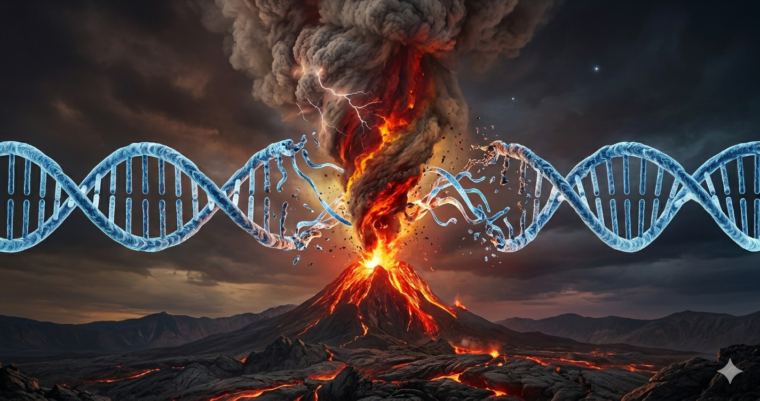
Buried in human DNA are sequences researchers call Human Accelerated Regions — HARs. These are sections of the genome that were essentially frozen across hundreds of millions of years of vertebrate evolution. Unchanged between chickens and chimpanzees. Conserved across species so different they share almost nothing else.
And then, specifically and rapidly, in the human lineage — they changed.
The standard explanation is that conservation indicates functional importance, and the human changes represent positive selection for new human-specific functions. That’s coherent. FOXP2, one of the better-known examples, is associated with the neurological infrastructure underlying language. ASPM and Microcephalin are linked to brain development.
But here’s what sits uncomfortably alongside that explanation: these sequences were conserved for roughly 300 million years and then changed rapidly and specifically in one lineage.
That’s what directed genetic engineering would look like from the outside.
The standard explanation and the Uplift explanation are, at the genomic level, essentially indistinguishable. Both predict exactly what we find.
Sit with that for a moment.
I’ll wait …
The Bottleneck
Roughly 74,000 years ago, the Toba supervolcano in what is now Indonesia erupted. It was, by any measure, a catastrophic event — the largest known volcanic eruption in the last 2 million years. The resulting volcanic winter may have lasted years. Global temperatures dropped. Ecosystems collapsed.
And the human population, already not large, may have dropped to as few as 10,000 individuals.
Ten thousand. The entire surviving human species, potentially small enough to fit in a single small town.
This is known as the Toba bottleneck, and it’s relevant here for a specific reason. A population that small, under that kind of pressure, is extraordinarily vulnerable — but it’s also extraordinarily malleable. Genetic changes that would take thousands of generations to spread through a large population can fix rapidly in a small founding group. Traits introduced at that moment would propagate through every subsequent generation.
If external intervention occurred anywhere in human prehistory, a post-bottleneck population of 10,000 individuals is precisely where you’d apply it.
You’d get rapid fixation of introduced traits. You’d get behavioral modernity appearing suddenly in the archaeological record shortly afterward.
Which is, in fact, exactly what we see.
I did tell you this was going to get uncomfortable.
And Then There Was One
For most of hominin history, multiple species coexisted. Not comfortably, not without competition, but they coexisted. H. erectus persisted for nearly two million years. Neanderthals were cold-adapted, large-brained, used pigment, buried their dead, and had survived in Europe for hundreds of thousands of years. Denisovans ranged across Asia. H. floresiensis had been doing fine on its island for a very long time.
And then, in a period that is essentially instantaneous by geological standards, they were all gone.
Not gradually outcompeted. Not slowly displaced over millions of years.
GONE.
Neanderthals by roughly 40,000 years ago. Denisovans shortly after. H. floresiensis by around 50,000 years ago. Every megafauna population that H. sapiens contacted collapsed. Every other hominid that encountered us disappeared.
This is the phase transition I mentioned in Part 1. One species stopped playing the same ecological game as everything else.
The standard explanation is competitive displacement — we were simply better. And that’s probably true, as far as it goes.
But “simply better” doesn’t quite capture a discontinuity that complete, that fast, across that many separate populations simultaneously.
The Uplift framework doesn’t struggle with this at all.
One lineage was modified. The rest weren’t. The outcome was inevitable from the moment the intervention occurred.
So What Does That Leave Us With?
A framework that wasn’t designed to explain human prehistory — but fits it anyway. Genomic signatures that look identical whether natural selection or directed engineering produced them. A catastrophic bottleneck at exactly the moment and scale where intervention would be most effective. A phase transition that eliminated every other hominid lineage with a speed and completeness that “competitive displacement” only partially explains.
The Uplift hypothesis doesn’t prove any of this. I want to be clear about that. What it does is accommodate the anomalies without straining. The standard narrative accommodates them too — but it has to work harder in places it would prefer not to discuss.
And here’s where the conversation took its next turn.
Because if the patron relationship was real — if something external shaped this specific lineage and then, for reasons we can’t recover, left — then the client species didn’t just lose its patron.
It lost everything the patron represented. The communication. The guidance. The framework for understanding what it was and why.
And a species without that framework will do what any intelligent, social, pattern-seeking organism does when it loses something essential.
It will try to get it back.
Every way it knows how.
For as long as it takes.
We’ll pick that up in Part 3.